
Pet Microchipping in Flint, MI: The Step After the Chip That Actually Brings Your Dog or Cat Home
The gate was latched. You're sure it was latched. But the yard is empty, the street is quiet, and your dog's collar is lying in the grass by the fence post.
A microchip is a permanent identification number implanted just beneath your pet's skin that a scanner can read at a veterinary clinic, a shelter or an animal control office. It is the one piece of identification that cannot slip off, fade out or be pulled loose, which is why pet microchipping in Flint, MI belongs on your calendar long before you ever need it.
Here's the part most articles skip. The chip itself is only half the job. The number under your dog or cat's skin brings them home only when it points to a registry record with a phone number you still answer. That second step is where this guide spends most of its time, because that is where families lose their pets.
Why a microchip matters more than a collar when your pet gets out
A microchip matters because it stays with your pet when everything else fails. Collars slip over heads, buckles snap on fences, and tags wear smooth until the engraving is a guess. The chip is still there, still readable, still yours.
What the shelter data actually shows
The numbers are not subtle. In a study of more than 7,700 stray animals entering shelters from August 2007 to March 2008, reported by the AVMA, dogs without microchips were returned to their owners 21.9% of the time versus 52.2% for microchipped dogs, while cats without microchips were reunited 1.8% of the time versus 38.5% for microchipped cats.
Read the cat figures again. For cats, the chip changes the picture entirely. The same AVMA reporting notes that when a microchipped animal was not returned, the usual reason was incorrect or missing owner information — not a failed chip, not a missed scan, but a record that had gone stale.
A microchip works with a collar and tags, not instead of them
Keep the collar on. The AVMA is clear that microchips do not replace collar ID tags or rabies tags, and the reason is practical: the neighbor two streets over who catches your dog can read a tag in ten seconds, while a chip needs a scanner and a trip to a clinic or shelter. Your pet's current rabies tag, which goes on after your dog's rabies vaccine, does the same immediate work.
Think of it as two layers. Tags get your pet home from the end of the block. The chip gets your pet home from the shelter.
The Flint-area reality: an open gate, a thunderstorm, a moving day
Around here it's usually one of three things. A contractor props the side gate. A July thunderstorm rolls over Genesee County and a dog who has never dug in his life goes under the fence. Or a family moves across town and the cat slips out the back door of a house she doesn't know yet.
None of those days come with a warning. A microchip improves the odds — it is not a promise. But it is the quiet, permanent layer of protection that sits under everything else you do, and it's a simple step to protect your dog or cat that takes a few minutes at a visit they're already due for.
What a pet microchip actually is — and what it is not
A pet microchip is a tiny electronic device sealed in a glass cylinder about the size of a large grain of rice, with no internal power source of its own. It sits inactive under the skin until a scanner's radio waves pass over it, at which point it transmits one thing: its identification number.
A passive ID number, not a tracking device
This is worth saying flatly, because it's the misconception we hear most. A microchip is not a GPS device and it cannot tell you where your pet is right now. It answers a different question — whose pet is this? — and only once someone already has your pet in hand.
If live location tracking is what you want, that's a separate collar-mounted product with a battery and a subscription. It is not what the chip does, and the two are not interchangeable.
Why your pet's chip has 9, 10, or 15 digits
The chip stores a unique identification number, nine, ten or fifteen digits long, and nothing else. Your name is not on it. Your phone number is not on it. Your address is not on it.
Those details live in a registry record attached to that number, maintained by a pet recovery registry such as HomeAgain, AKC Reunite, 24PetWatch or PetLink. Hold onto that distinction, because it is the whole argument of the next section.
ISO chips, older frequencies, and universal scanners
Pet microchips in the United States commonly operate at 134.2 kHz, 125 kHz, or less often 128 kHz. The ISO standard — an international specification so that a chip implanted in one country can be read in another — is 134.2 kHz with a 15-digit number. Universal scanners read all of those frequencies, which is why clinics, shelters and animal control agencies use them.
Adopted and imported pets sometimes turn up with two chips at different frequencies. That is not a problem in itself; two chips do not interfere with each other. What matters is that each one's registry record is current, because a scanner may find either one.
What the appointment is actually like for your dog or cat
The chip is implanted just beneath the skin, typically between the shoulder blades, using a preloaded syringe and a sterile needle. No surgery and no anesthesia are required, so it can be done during an ordinary visit while your pet is sitting on the exam table.
No surgery, no anesthesia — and the spay/neuter option
The AVMA describes the process as no more painful than a typical injection, although the needle is slightly larger than those used for vaccines. Most dogs and cats react about the way they do to a routine shot — a quick pinch, a treat, done.
If your pet is already scheduled to go under anesthesia for something else, say so when you book. A chip can be implanted while a pet is anesthetized for spay and neuter surgery in Flint, which means one less separate visit on your calendar.
Why implantation belongs with a veterinarian
Placement is the reason this isn't a kit you order online. The location and depth determine whether the chip can be found and read years from now, and incorrect placement can make a chip hard to detect or occasionally cause complications. The AVMA's position is that microchips should be implanted by a veterinarian or under veterinary supervision.
There's a continuity argument too. When the chip goes in at the practice that holds your pet's record, the number lands in a medical file you can call and ask about later.
What to watch for afterward
Complications are uncommon. The issue reported most often is migration — the chip drifting from its original site — which usually doesn't affect your pet's health but can make it harder to find without a complete scan of the whole body. Call us if you notice drainage or swelling at the implant site.
Owners also ask about cancer, and it deserves a straight answer rather than a dodge. A very small number of tumors have been reported near microchip implantation sites in dogs and cats. Those reports are extremely rare, and a cause-and-effect relationship has not been established.
Registration is the step that brings your pet home — and it is the step most owners miss
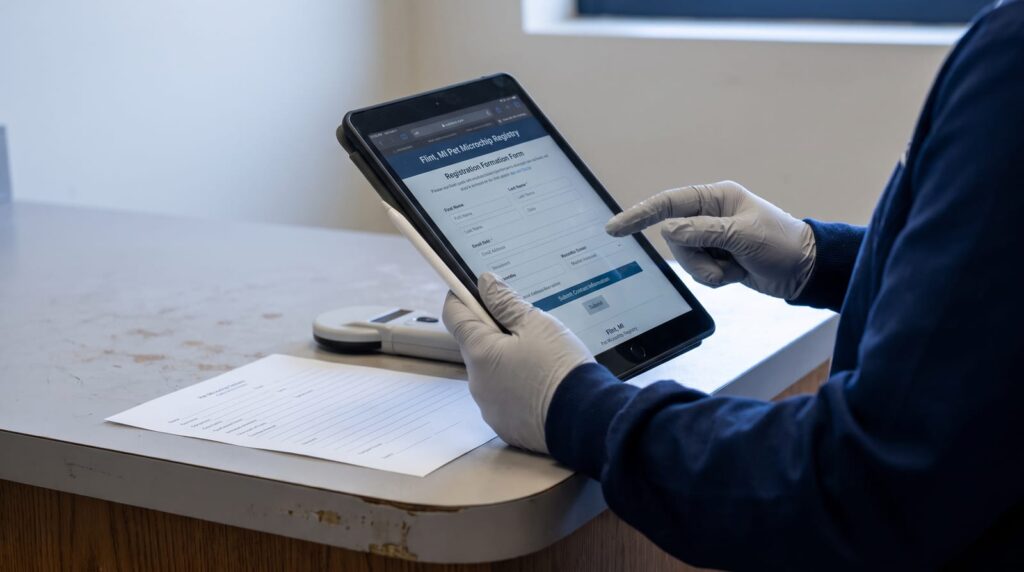
Implanting the chip and registering the chip are two separate steps. A chip that was never registered is a number that leads nowhere: the shelter scans your dog, reads fifteen digits, and finds no one to call.
There is no single national microchip database
The United States has no centralized database for pet microchips. Chips are registered with one or more private registries, each keeping its own records, which is why "he's chipped" and "he's findable" are not the same sentence.
What goes wrong: the disconnected phone number
The failure modes are depressingly ordinary. Ohio State University reported that across 53 shelters in 23 states, owners were found for 72.7% of microchipped animals — and that among the animals whose owners could not be found, 35.4% had an incorrect or disconnected telephone number on file, 24.3% of owners did not respond to calls or a letter, 17.2% were registered with a different database than the one contacted, and 9.8% of chips were unregistered.
Not one of those is a technology failure. Every one of them is a paperwork failure, and every one of them is fixable from your kitchen table in about ten minutes.
Register the day the chip goes in
Three habits cover it:
- Register the chip with a pet recovery registry as soon as it's implanted, rather than filing the paperwork in a drawer.
- Ask for a scan at least once a year at your pet's checkup, to confirm the chip still reads and hasn't migrated.
- Update your contact details after every move, every new phone number, and every change in who the emergency contact should be.
A current registry record is what turns a scan into a phone call. If you'd like a date to hang it on, August 15 is Check the Chip Day, sponsored by the AVMA and AAHA — a reasonable annual reminder to log in and look at what your pet's record actually says.
How to find out whether your pet's chip is registered, and to whom
You can answer this today, for free, in three steps.
Step 1: Get the microchip number
Look at the paperwork from the implant visit, your adoption packet, or the vaccination records you were handed when you brought your pet home. If none of that survived the last move, ask your veterinary team to scan your pet at the next visit and write the number down. Our guide to track down your pet's past health records covers the rest of that paper trail.
Step 2: Run it through the AAHA Universal Pet Microchip Lookup Tool
The AAHA Universal Pet Microchip Lookup Tool is free, accepts a 9-, 10- or 15-digit microchip number, and tells you which participating pet recovery registries hold a record for that number. It does not display owner contact information, it is not a place to register or update a chip, and it searches only registries that choose to participate.
Step 3: Call the registry the tool names
You'll get one of three answers. A registry name is the good outcome — call them and confirm the phone number on file is the one in your pocket. A manufacturer name only usually means the chip was distributed but registration was never completed. Nothing at all means no participating registry has a record. The second and third outcomes feel alarming and are usually a ten-minute fix, not a crisis.
Adopted, rehomed, or breeder pets: the most common gap
If your dog came from a shelter or your kitten came from a breeder, there's a good chance a chip is already in there — and a good chance its record still points at the shelter, the breeder, or the family before you. Have your pet scanned and the record transferred into your name. Paying to implant a second chip is almost never the answer.
Scanning at every annual visit matters for a practical reason: detection can be hindered by a pet who won't hold still, long matted hair at the site, excessive fat deposits in the area, or a metal collar. That's why a complete scan with a universal scanner is the standard, and why a routine wellness exam is the natural place to do it.
Your pet is missing in Genesee County: what to do in the first few hours
Move now rather than waiting a day to see if they wander back. Work the list in order:
- Call the registry holding your pet's record and flag the chip as lost.
- Contact Genesee County Animal Control. The county operates the county shelter, sells dog licenses, and works to reunite lost pets with their owners — ask them directly how they want a lost pet reported and how often you should check in.
- Post with local lost-pet groups and your neighborhood networks.
- Keep your phone with you and answer it. Per the data above, an unreachable number is the single most common reason a found pet doesn't make it home.
If you're on the other side of this — you found someone's dog — take the animal somewhere it can be scanned and ask specifically for a complete scan with a universal scanner. A single-frequency unit can miss a chip entirely and report a chipped animal as unchipped.
Eascor Animal Hospital is closed Wednesday and Sunday. For after-hours emergencies, contact a 24-hour emergency veterinary facility.
What to ask before you book pet microchipping in Flint, MI
The questions that matter are about registration and scanning, not just about the implant itself. Anyone can put a chip in. What you want to know is what happens to the number afterward.
Questions worth asking any veterinary team
- Is registration handled before I leave, or is that mine to complete?
- Which registry will my pet's number be enrolled in?
- Will you scan my pet first, in case there's already a chip in there?
- Can the chip be placed at a visit my pet is already due for?
- Do you use a universal scanner?
On cost, ask what the quote covers: the chip, the implant, and whether registration is included. Those three line items are what make two numbers comparable, so ask when you call rather than guessing from a website.
Bundling the chip with a visit your pet already needs
The easiest microchip appointment is the one you were already making. A chip can go in while you're bringing home a new puppy or caring for a new kitten, at your dog's annual wellness exam, alongside pet vaccinations, or during a spay or neuter while your pet is already anesthetized. You can see the full picture on our microchipping service page.
A dog license and a microchip record are not the same thing
These two records do two different jobs. A Genesee County dog license is a county record of your dog; a microchip registry record is a private record linking an ID number to your contact details. Updating one does not update the other. Take licensing questions — what's required, when, and how — directly to the county, since those rules are theirs to state.
If travel is in your future, keep it on your radar early. Many countries require a 15-digit microchip for entry, and a microchip is required for all dogs returning to the U.S. Confirm the paperwork with your veterinarian and against the USDA APHIS pet travel requirements well ahead of the trip, not the week before.
Common questions Flint pet owners ask about microchips
Does a microchip hurt my dog or cat?
The process is no more painful than a typical injection, although the needle is slightly larger than those used for vaccines. No surgery and no anesthesia are needed, and most pets are back to themselves before they're off the table.
How long does a pet microchip last?
Microchips are designed to last your pet's lifetime and contain no battery, so they generally don't wear out or need replacing. Still worth asking for a scan at routine checkups to confirm the chip reads.
Can a microchip tell me where my lost pet is right now?
No. A microchip is not a GPS device and cannot show your pet's location. It identifies your pet as yours once someone already has them.
My pet was chipped years ago — does anything need checking?
Two things: that the chip still scans, and that the registry record still carries a phone number you answer. Run the number through the lookup tool described above, then call whichever registry it names.
At what age can a puppy or kitten be microchipped?
A chip can be placed during a routine visit, and the right timing for your particular puppy or kitten is a short conversation with your veterinarian. Bring it up at the first wellness appointment and you'll likely never have to think about it again.
Are there risks or side effects from microchipping?
Complications are uncommon. Migration of the chip from its original site is the issue reported most often, and tumors near implantation sites in dogs and cats are extremely rare with no established cause-and-effect relationship.
This article is for general educational purposes and is not a substitute for examination, diagnosis, or treatment by a licensed veterinarian. Individual results vary by patient. No treatment outcome is guaranteed.
We treat your pets like family, and a microchip is one of the quietest ways we know to keep a family together. If your dog or cat isn't chipped yet — or you're not sure the record still has your current number on it — schedule an appointment or give us a call and we'll scan, check and sort it out. You can see everything else we offer on our veterinary services in Flint, MI page. We look forward to meeting you and your furry family members.