
Senior Cat Arthritis Symptoms: Why She Stopped Jumping on the Bed
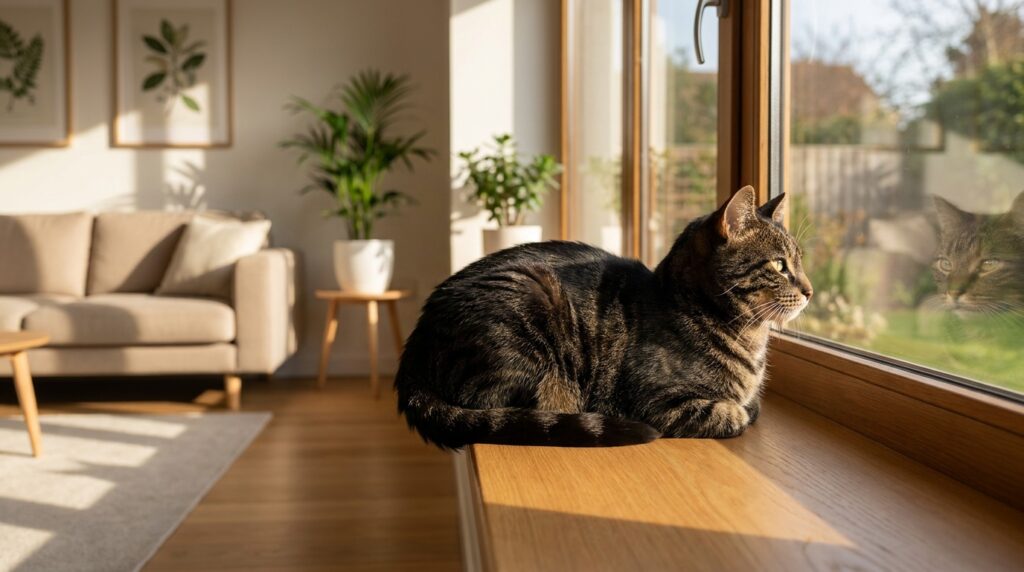
She stopped jumping on the bed. If you have noticed that and wondered whether she is simply getting old, you are already watching the right thing. It is often the first way a cat tells you her joints hurt. The earliest senior cat arthritis symptoms are usually things your cat stops doing rather than things she starts doing. No limp, no cry, just a quietly edited routine. A dog with sore joints shows you. A cat rewrites her day so you never notice.
Senior Cat Arthritis Symptoms Start With What She Stopped Doing
The earliest signs at home are absences: fewer jumps, shorter jumps, less grooming, a little less of her. If you are waiting for a limp before you call your veterinary team, you may wait a long time.
The jump she no longer attempts
The FDA's Center for Veterinary Medicine reports that in a study of 28 cats with osteoarthritis, less than half limped, almost three-quarters didn't want to jump, and two-thirds jumped a shorter distance.
Watch for lower landings. The chair instead of the counter. The floor instead of the windowsill. A two-step route up to the bed where there used to be one clean leap. Cats rarely stop going where they want to go. They find an easier way to get there, and that workaround is the symptom.
Grooming, coat and litter box changes
Signs of osteoarthritis in cats, according to the FDA, include weight loss, loss of appetite, decreased activity level, change in attitude, decreased grooming, urinating or defecating outside the litter pan, and not being able to jump as easily as before.
A "change in attitude" usually means grumpier or quieter than she used to be. And Cornell's Feline Health Center notes that a cat with joint pain may be unable to groom itself thoroughly. A dull, matted patch over the lower back and hips is a mobility clue, not a hygiene problem. She can't twist to reach it.
Stiffness in the first minutes after a nap
Cornell's Feline Health Center describes the earliest visible sign of degenerative joint disease as apparent stiffness and a subtle reduction in the cat's activity. Subtle is the operative word. You will not catch this on a single Tuesday; you catch it by comparing this month to six months ago.
Why Cats Hide Arthritis — and How to Tell Pain From Normal Aging
Cats hide joint pain because concealing weakness is a survival instinct, and because their small size and natural agility let them compensate for sore joints far longer than a dog can.
A survival instinct, not stoicism
Cornell attributes reclusive, slowed-down behavior to a deeply ingrained feline instinct for self-protection: a cat may conceal its disability for fear of alerting a potential predator to its vulnerability. She isn't being brave for you. She's being a cat.
If you also have a dog at home, the contrast is useful. The canine version announces itself much more loudly, and the dog pain symptoms to look out for are a different list entirely.
How common joint disease really is in older cats
Cornell's Feline Health Center reports that X-rays of 100 cats aged 10 or older revealed 90 percent of cats over the age of 12 showed evidence of degenerative joint disease, and another study suggested 20 percent of all cats one year of age and older are already arthritic to some extent.
Three words, one condition: arthritis means joint inflammation, osteoarthritis (OA) is the wear-related form where cartilage (the smooth cushion at the end of each bone) breaks down, and degenerative joint disease (DJD) is the broader umbrella your veterinarian may write in the chart.
The sentence to stop telling yourself: "she's just old"
Cornell's senior cat guidance puts it plainly: never assume that changes you see in your older cat are simply due to old age and are therefore untreatable.
Cornell also notes that degenerative joint disease is seen more frequently in overweight cats, has no gender predisposition, and that the only notable breed disposition is in Maine Coons, who are more susceptible to hip dysplasia.
A One-Week Mobility Journal to Bring to Your Appointment
One week of notes is the single most useful thing you can hand your veterinary team, because the exam room is the one place your cat will not behave normally.
The FDA explains why: cats can tolerate bone and joint problems because of their small size and natural agility, they hide their pain very well, and they generally dislike being handled during physical examinations, so the owner's observations at home give the veterinarian the best picture. The FDA also notes a veterinarian may ask the owner to complete a questionnaire specific to cat behavior and pain, so it's worth asking whether your team would like one filled out before you come in.
Six things to write down this week
- Attempted jumps versus completed jumps.
- Which surfaces she chooses now, compared with six months ago.
- Whether she can reach her lower back and hips when grooming, and where mats are forming.
- Litter box entry: hesitating, perching on the edge, or going beside the box.
- How she moves in the first ten minutes after a long nap.
- Appetite, and any change in weight.
What to film on your phone
A ten-second clip of your cat approaching a jump, taking the stairs, or stepping into the litter box is worth more than your best description from memory. Film her as she is, in the room she usually uses.
What not to do: never make her jump to test her
Don't lift her onto the counter to see whether she'll come down, and don't coax her into a leap she's avoiding. Observe what she chooses. The journal prepares the appointment, it doesn't replace it, and the exam is still where the answer comes from. When you have a week of notes in hand, schedule an appointment and bring them with you.
What the Exam Looks For — and Why X-Rays Are Only Part of the Picture
Diagnosis in cats combines the history you bring, a hands-on physical and orthopedic exam, and imaging. In cats, imaging alone is not the final word.
Cornell describes the path as a complete medical history and overall physical examination, followed by an orthopedic exam and X-rays of the cat's joints. The orthopedic portion is mostly fingers: gentle palpation along each joint, and moving the limb through its range of motion to find where she tightens, pulls away or flicks her tail.
What radiographs can and cannot show in a cat
The FDA reports that X-ray changes in cats are less severe than in dogs, that cats with osteoarthritis sometimes have no changes on their X-rays, and that in a study of 13 cats, half the joints had osteoarthritis but only 10% of joints were both painful and showed X-ray changes.
Read that the other way around: a clean set of veterinary X-rays does not mean your cat is comfortable. That mismatch is exactly why your week of home observations carries weight, and why it belongs in the conversation with your veterinarian alongside the films.
Where feline arthritis sits, and what else gets ruled out
The FDA notes the most common joints to develop osteoarthritis in cats are the elbows and hips, although shoulders, hocks (ankles) and knees can also be affected, and arthritis in the backbone and sternum is also common. What owners usually notice first isn't the joint itself. It's the behavior: hesitating at the stairs, or stopping jumping onto the bed.
Other conditions common in older cats change how they move, eat and use the litter box, so the workup looks past the joints. Kidney disease in cats is one example worth reading about, and we cover bloodwork timing in more depth in senior cat care and kidney screening. Ask your veterinarian what bloodwork or imaging they recommend alongside the orthopedic exam.
Making Your Home Kinder to Sore Joints
Most of what helps an arthritic cat day to day costs nothing and takes an afternoon. You're removing the jumps she can no longer make comfortably.
Non-drug options, per the FDA, include weight loss for overweight cats, increased exercise or physical rehabilitation, litter pans with lower sides for easier entering and exiting, raised food and water bowls, ramps and steps for getting to high places, and soft bedding.
Cornell explains why this matters so much: most arthritic cats don't become overtly lame, but they may struggle to reach litter boxes and food and water dishes. The practical translation is simple: put a litter box on every floor she uses, and move her water somewhere she doesn't have to climb for it.
Cornell also notes that a cat with a severe joint problem may become constipated because it can't position itself properly to defecate. Straining and missed boxes are medical news, not bad manners. Report them.
Brush the spots she can no longer reach, gently and briefly, and check the hips and lower back for mats. Keeping her at a healthy weight takes real strain off sore joints, so talk through a healthy at-home weigh-in routine with your veterinarian before you change her food. And gentle movement still matters at this age. Keeping an indoor cat active supports the joints rather than sparing them into stiffness.
Comfort Care Options Your Veterinarian May Discuss
The FDA frames the goal honestly: once osteoarthritis develops, the changes to the joint can't be reversed, but the disease can be slowed down to help keep the joint working as well as possible for as long as possible.
Why cats need cat-specific pain medicine
The FDA reports that no veterinary NSAIDs (non-steroidal anti-inflammatory drugs) are currently approved for safe, long-term control of pain and inflammation due to osteoarthritis in cats, and that cats are especially sensitive to the side effects of NSAIDs.
So here is the hard rule: never give your cat any pain medicine that was not prescribed for that cat. Not from your own medicine cabinet, not from the dog's bottle, not half of anything. The FDA also notes that Solensia, a monoclonal antibody injection, is approved to treat pain caused by osteoarthritis in cats, and that it works by decreasing the pain signals associated with osteoarthritis. Whether it fits your cat is a conversation for your veterinarian.
Supplements, laser therapy and acupuncture come up often in these appointments too. Your veterinarian will advise what suits your cat, her other conditions and her medications.
Setting honest expectations
Cornell describes palliative treatment relying largely on pain medication and attentive home care as the approach most often recommended, with the aim of relieving discomfort and supporting a reasonably good quality of life. Many cats stay comfortable for years with the right plan, built around pet pain management and consistent elder pet care.
Individual results vary by patient. No treatment outcome is guaranteed.
Frequently Asked Questions
At what age do cats get arthritis, and how common is it?
Joint disease is a senior problem but not only a senior problem. Cornell's Feline Health Center reports that 90 percent of cats over the age of 12 showed evidence of degenerative joint disease on X-rays, and that another study suggested 20 percent of all cats a year old and up are already arthritic to some extent.
Can arthritis in cats be reversed?
No. The FDA states that once osteoarthritis develops, the changes to the joint can't be reversed, but the disease can be slowed down to help keep the joint working as well as possible for as long as possible. Arthritis is managed rather than reversed, and the goal is comfort.
Do X-rays always show arthritis in a cat?
No. The FDA reports that cats with osteoarthritis sometimes have no changes on their X-rays at all, and that X-ray changes in cats are less severe than in dogs. A clean film does not rule out joint pain, which is why the hands-on exam and your home observations matter so much.
Why has my senior cat started going outside the litter box?
Because getting in may now hurt. High sides, a lid, a climb or a flight of stairs can each be enough. Swap in a pan with lower sides, add a box on every floor she uses, and tell your veterinarian. It's a mobility sign, not a behavior problem.
Can I give my cat pain medicine from my own medicine cabinet?
No. Human medications and dog prescriptions can be dangerous for cats, and cats are especially sensitive to NSAID side effects. Pain control for your cat has to be prescribed for your cat.
When to Book an Appointment for Your Senior Cat's Mobility
Changes that deserve an appointment soon
- A jump she suddenly refuses
- Crying out when touched or lifted
- A new limp, however mild
- Accidents outside the litter box
- A coat going unkempt or matted over the hips
- Several small changes showing up together
A wellness exam is the right place to start if nothing is urgent but something feels off. Any sign of sudden pain or distress, in any part of your pet, deserves a call right away rather than a wait-and-see.
After hours
This hospital does not provide emergency care. If something happens outside office hours, go directly to a 24-hour emergency veterinary facility.
Eascor Animal Hospital is closed Wednesday and Sunday. For after-hours emergencies, contact a 24-hour emergency veterinary facility.
Where this fits in your senior cat's care
Mobility is one chapter of a longer story that also includes bloodwork, dental health, weight and comfort. Our broader guide to senior pet care in Flint, MI walks through the rest of it.
Bring your week of notes and that short video, schedule an appointment or give us a call, and we'll go through what you've seen together. We treat your pets like family, and your older furry family member deserves to get up on the bed again.
This article is for general educational purposes and is not a substitute for examination, diagnosis, or treatment by a licensed veterinarian.